
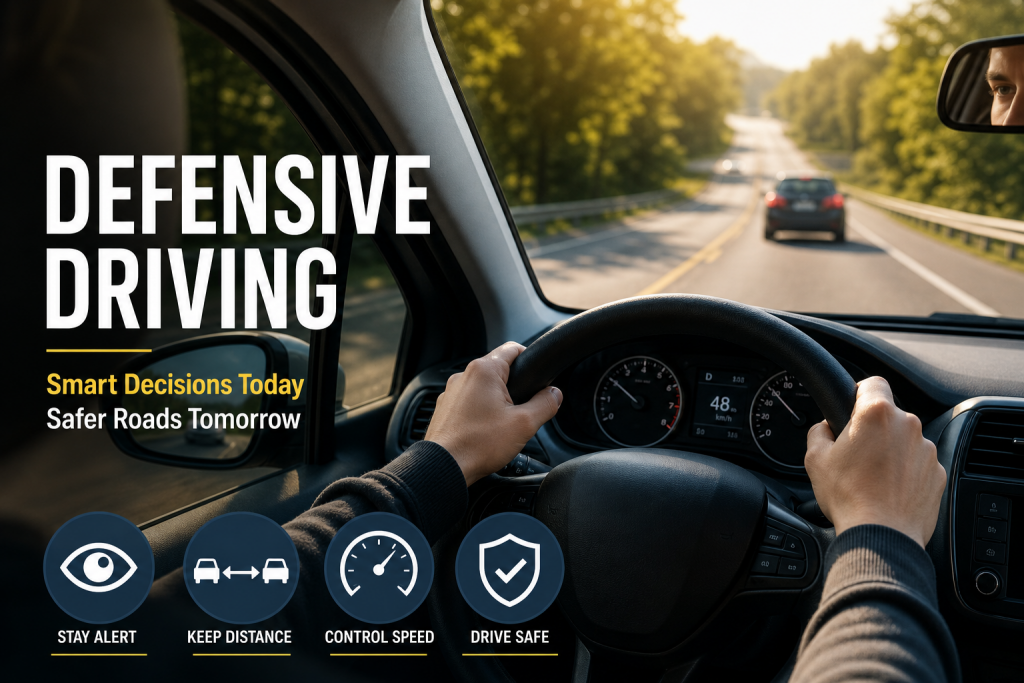
 Why Defensive Driving is Essential for Every New Driver
Learning how to drive is a major life milestone, but becoming a safe and responsible driver requires much more than simply understanding how to operate a vehicle. For new drivers in Canada, the first year on the road is statistically the most dangerous due to inexperience, lack of hazard awareness, and slower reaction times.
Defensive driving techniques are specifically designed to reduce these risks by teaching drivers how to anticipate potential hazards, make informed decisions, and maintain control in unpredictable situations. Unlike basic driving skills, defensive driving focuses on prevention rather than reaction.
In today’s increasingly complex driving environment, where distracted driving, aggressive behavior, and changing road conditions are common, defensive driving is not optional – it is essential.
What is Defensive Driving – A Strategic Approach to Road Safety
Defensive driving is a proactive driving philosophy that emphasizes awareness, anticipation, and risk management. Instead of assuming that all road users will follow traffic rules, defensive drivers prepare for unexpected actions from others and adjust their driving accordingly.
This approach includes:
- Continuous observation of surroundings
- Predicting potential hazards before they occur
- Maintaining safe distances and speed
- Making calculated and controlled driving decisions
For new drivers, adopting this mindset early can significantly reduce accident risk and improve long-term driving habits.
Why New Drivers Are at Higher Risk on the Road
Understanding risk factors is critical for improving safety. New drivers face several challenges that increase their likelihood of accidents:
– Limited Real-World Experience
Driving schools teach fundamentals, but real-world scenarios require quick decision-making and adaptability.
– Reduced Hazard Perception
New drivers often struggle to identify potential dangers early enough.
– Overconfidence or Nervousness
Some drivers become overly confident, while others hesitate excessively, both of which can lead to poor decisions.
– Distractions
Mobile phones, passengers, and in-car technology can divert attention.
– Inconsistent Driving Behavior
New drivers may have difficulty maintaining consistent speed, lane positioning, and control.
Defensive driving training directly addresses these issues by improving awareness, judgment, and control.
Core Defensive Driving Techniques Every New Driver Must Master
– Maintain Proper Following Distance
One of the most critical defensive driving techniques is maintaining a safe distance from the vehicle ahead. The widely recommended method is the 3-second rule, which allows sufficient time to react to sudden stops or hazards.
In poor weather conditions such as rain or snow, this distance should be increased to 4 to 6 seconds.
– Constantly Scan the Road Environment
Defensive drivers do not focus only on the vehicle directly ahead. Instead, they continuously scan:
- Vehicles in adjacent lanes
- Pedestrians and cyclists
- Traffic signals and road signs
- Potential hazards such as construction zones
This habit improves reaction time and reduces the likelihood of surprises.
– Always Check Blind Spots
Mirrors alone are not sufficient. Blind spots can hide vehicles, especially during lane changes. Always perform a shoulder check before changing lanes or merging.
– Control Speed Based on Conditions
Speed limits are designed for ideal conditions, but real-world driving often requires adjustments. Defensive drivers reduce speed when:
- Roads are wet or icy
- Visibility is low
- Traffic is heavy
- Driving in unfamiliar areas
– Avoid Distractions Completely
Distracted driving is one of the leading causes of accidents in Canada. Defensive drivers eliminate distractions by:
- Keeping mobile devices out of reach
- Avoiding multitasking
- Staying mentally focused on driving
– Anticipate the Actions of Other Drivers
Never assume that other drivers will behave predictably. Be prepared for:
- Sudden lane changes
- Unexpected stops
- Failure to signal
- Running red lights
Anticipation allows you to respond safely rather than react suddenly.
– Use Smooth and Controlled Movements
Sudden braking, acceleration, or steering can lead to loss of control. Defensive drivers maintain smooth and gradual movements to ensure stability.
– Be Extra Cautious at Intersections
Intersections are among the most common locations for accidents. Always:
- Check both directions before proceeding
- Be prepared for drivers who ignore signals
- Approach with reduced speed
Defensive Driving in Different Conditions
– Driving in Rain
- Increase following distance
- Reduce speed
- Avoid sudden braking
- Use headlights for visibility
– Driving in Snow and Ice
- Drive slowly and steadily
- Avoid sharp turns
- Brake gently
- Keep extra distance between vehicles
– Night Driving
- Reduce speed due to limited visibility
- Watch for pedestrians and animals
- Avoid looking directly at oncoming headlights
– Driving in Heavy Traffic
- Stay patient and avoid aggressive driving
- Maintain consistent speed
- Keep a safe gap between vehicles
Psychological Aspects of Defensive Driving
Driving is not just a physical skill – it is also psychological. Defensive drivers maintain:
– Emotional Control
Avoid road rage and frustration.
– Focus and Attention
Stay mentally engaged at all times.
– Confidence Without Overconfidence
Balance confidence with caution.
Common Mistakes New Drivers Make – And How to Avoid Them
– Following Too Closely
Solution – Always maintain safe distance.
– Ignoring Blind Spots
Solution – Make shoulder checks a habit.
– Speeding or Driving Too Slowly
Solution – Match speed to traffic and conditions.
– Hesitation in Decision Making
Solution – Practice controlled and confident actions.
– Overlooking Road Signs
Solution – Stay alert and observant at all times.
Benefits of Learning Defensive Driving from a Professional Driving School
Self-learning has limitations. Professional training provides structured and comprehensive learning that includes:
- Real-world driving scenarios
- Expert feedback and correction
- Step-by-step skill development
- Test preparation and evaluation
Professional instructors help new drivers develop safe habits from the beginning, which reduces long-term risk.
Long-Term Benefits of Defensive Driving
Adopting defensive driving techniques early offers lasting advantages:
- Reduced accident risk
- Lower insurance premiums
- Improved driving confidence
- Better decision-making skills
- Safer roads for everyone
How Defensive Driving Helps You Pass Your Driving Test
Driving examiners evaluate more than basic vehicle control. They assess:
- Awareness of surroundings
- Proper use of mirrors and blind spots
- Smooth and controlled driving
- Compliance with traffic rules
Defensive driving techniques directly improve these areas, increasing your chances of passing on the first attempt.
Frequently Asked Questions – Defensive Driving
What is the most important defensive driving skill
Awareness and anticipation are the most critical skills for avoiding accidents.
Can defensive driving reduce insurance costs
Yes, many insurance providers offer discounts for certified defensive driving training.
How long does it take to learn defensive driving
With proper training, basic defensive driving skills can be developed within a few weeks, but mastery comes with experience.
Conclusion – Build a Strong Foundation for Safe Driving
Defensive driving is not just a technique – it is a lifelong skill that protects you and others on the road. For new drivers, learning these techniques early creates a strong foundation for safe, confident, and responsible driving.
If you want to reduce risks, improve your skills, and gain real confidence behind the wheel, professional training is the most effective path forward.
Call to Action
Start your journey toward safer driving today. Learn from certified instructors and build real-world driving confidence with expert training at https://avondrivingschool.ca/